
hCG levels: all you need to know

Most home pregnancy tests detect hCG at around 25 mIU/ml. Clearblue Early Detection and Early Digital Pregnancy Tests can detect hCG from 10 mIU/ml. The lower the hCG sensitivity, the smaller the amount of pregnancy hormone needed for a positive result.
You may have heard about the so-called pregnancy hormone, but what is it? All pregnancy tests detect the presence of the hormone hCG, or human chorionic gonadotropin to give its scientific name, in either blood or urine. If you’d like to know why your body produces hCG, how its levels go up, what hCG levels can tell your doctor and whether it causes morning sickness, read on.
In this article
- What is hCG?
- What is the role of hCG?
- How do your hCG levels change during early pregnancy?
- hCG in perimenopause
- What does a lower hCG sensitivity level mean to me?
- How do pregnancy tests use hCG to detect pregnancy?
- How do twins and multiples affect hCG levels?
- Can hCG levels diagnose a miscarriage or an ectopic pregnancy?
- FAQs about hCG
What is hCG?
Human chorionic gonadotropin (hCG) is a hormone that’s made first by the embryo and then by the placenta. This hormone stimulates the production of increased estrogen and progesterone during pregnancy and is the hormone detected by all pregnancy tests, whether at home in your urine, or in a blood test at the doctor’s office. It's generally measured in milli-international units per milliliter (mIU/ml).
What is the role of hCG?
The hCG hormone plays a vital role in early pregnancy as it promotes progesterone production by the corpus luteum1, the bit that’s left over when the egg is released from the ovary. HCG, together with hormones like progesterone and estrogen, also helps maintain the uterus lining. It also stimulates the thyroid gland2 and supports the implantation of the blastocyst (which will later develop into the baby). Since this hormone is produced by the fertilized egg and later the placenta, it’s a useful hormone to detect pregnancy.
How do your hCG levels change during early pregnancy?
The levels of hCG rise rapidly in the earliest days of pregnancy and can be detected around eight days after the estimated day of conception in the blood by the most sensitive laboratory methods. Home pregnancy tests can detect it a few days later in urine depending on their sensitivity. HCG levels rise quickly and exponentially, usually doubling every 2 days3,4 in the first weeks before reaching a steady level (plateau) around week 10, after which time they slowly decline.

hCG in perimenopause
In the USA and across much of the developed world, women are waiting longer to start a family. Data from the CDC shows birth rates have increased for women in their early 40s since the 1980s6. This increase in women seeking pregnancy later means that more women could be in peri or postmenopause when taking a pregnancy test.
Though hCG (human chorionic gonadotropin) is known as ‘the pregnancy hormone’ a very small number of non-pregnant peri and postmenopausal women can have very low levels of hCG in their urine due to changing hormone levels associated with the menopause transition. Notably the rise in FSH (follicle stimulating hormone) which is associated with approaching menopause can result in tiny amounts of hCG being produced in a very small number of women. In a Clearblue® clinical study 3% of perimenopause women (40-50y) had a urine hCG concentration >5mIU/ml.
Figure 1: Mean, 10th and 90th centiles of urinary FSH and hCG concentrations in pre-, peri- and post-menopausal women (FSH and hCG in mIU/ml). 397 urine samples (97 pre- (age 18-40), 150 peri- (age 41 to 55) and 150 post-menopausal (age 56-65)) were collected from volunteers who participated in a urine collection study conducted by Clearblue®.
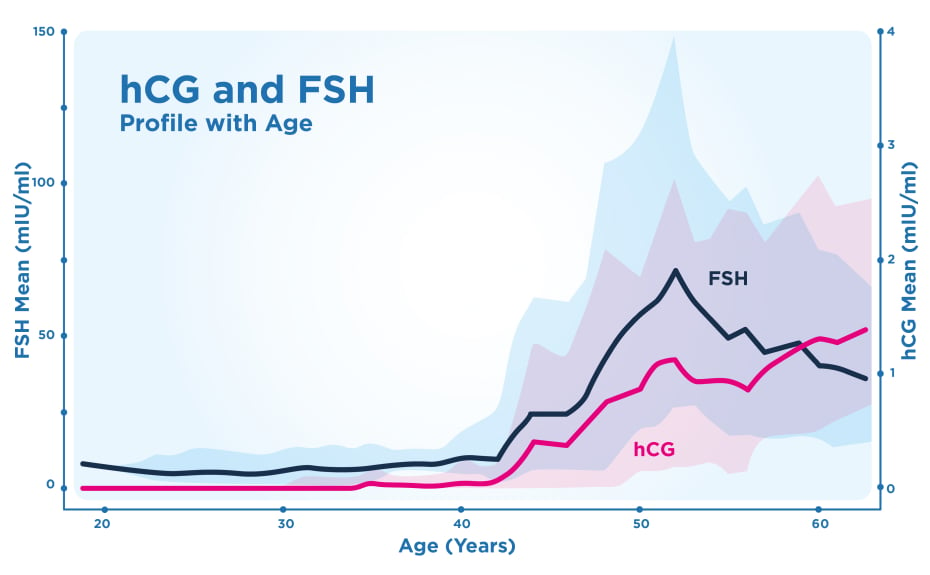
This small number of non-pregnant peri and postmenopausal women who may have very low levels of hCG in their urine could carry the risk of returning a false positive result should these women use a high sensitivity test for hCG, such as one that can be used very early.
That’s why Clearblue® Early Detection Pregnancy Test includes DualSenseTM Technology, to offer women the clinical benefits of early testing, and for the very small number of non-pregnant women who may have low levels of hCG in their urine, the potential for a reduced risk of false positives by detecting hCG and recognising the presence or absence of high levels of FSH. If hCG is raised in the presence of high levels of FSH, the hCG is unlikely to be due to pregnancy and thanks to DualSenseTM Technology the test should deliver a negative result.
What level of hCG can pregnancy tests detect?
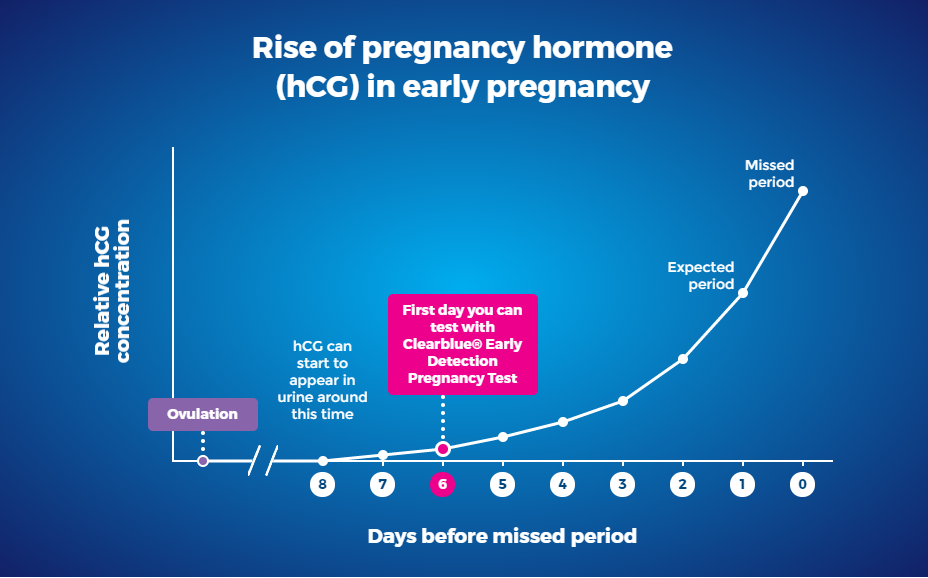
HCG starts to appear in tiny amounts in urine around 7 - 9 days after ovulation. One study showed a median concentration of 4 mIU/ml on day 9 and 12 mIU/ml by day 10, showing the rapid rise that occurs in early pregnancy5.
So, what does this mean? With the very rare exceptions eg. certain medical conditions, or if you’ve taken medication containing hCG before testing, if your pregnancy test detects the presence of hCG, you are pregnant. However, even if your result is negative, if you are very early into your pregnancy you could still be pregnant, because hCG levels are still low. For example, a week after you’ve conceived (approximately one week after ovulation), the hCG levels in your urine are still very close to zero.
Generally, most home pregnancy tests claim to detect hCG levels from 25 mIU/ml. However, some tests, such as the Clearblue® Early Digital Pregnancy Test and the Clearblue® Early Detection Pregnancy Test, are so sensitive they can detect hCG levels as low as 10 mIU/ml.
Test Sensitivity Comparison Table
| Clearblue® Pregnancy Test | hCG Sensitivity |
| Early Detection | 10 mIU/ml |
| Early Digital | 10 mIU/ml |
| Rapid Detection | 25 mIU/ml |
What does a lower hCG sensitivity level mean to me?
A lower test sensitivity level means the test needs less pregnancy hormone in your urine to give a positive result. Because hCG rises quickly in early pregnancy, needing less of it means you may be able to test a little sooner.
But sensitivity is only half the picture. Whether a test can detect your pregnancy on a given day depends on two things:
- How much hCG the test needs to accurately show a positive result (its sensitivity — 10 mIU/ml or 25 mIU/ml)
- How much hCG your body has produced so far (varies from woman to woman and can depend on factors such as when the fertilized egg implanted)
This is why a very sensitive test can still give a “Not Pregnant” result when you are pregnant — there simply may not be enough hormone present yet. The most reliable time to test is from the day you expect your period, when all Clearblue® pregnancy tests are over 99% accurate.
Pregnancy detection rates when testing early
Detection rates increase every day as hCG levels rise. The table below shows laboratory testing results — the percentage of pregnancies detected on each day.
| Days before your missed period | Percentage of pregnancies detected with Clearblue® Early Detection |
| 6 days before | 77% |
| 5 days before | 93% |
| 4 days before | 98% |
| From 3 days before | Over 99% |
What this means
At 6 days before your missed period, our most sensitive tests detect most — but not all — pregnancies. Each day you wait, the chance of the test being able to detect your pregnancy increases.
A “Pregnant” result is highly reliable at any point. A “Not Pregnant” result before your missed period is less reliable — if your period does not arrive, test again or see your Doctor.
Rise of pregnancy hormone
(hCG) in early pregnancy
concentration
period
period
Adapted from: Gnoth C. and Johnson S. Strips of Hope: Accuracy of Home Pregnancy Tests and New Developments. GeburtshilfeFrauenheilkd 2014;74(7):661–669. © 2023 SPD Swiss Precision Diagnostics GmbH (except for any third-party content identified as such). All rights reserved.
| Point in timeline | What happens in early pregnancy |
| Ovulation | Egg is released from the ovary |
| Around 7-9 days before missed period | hCG may begin appearing in urine |
| 6 days before missed period | Earliest you can test with our most sensitive tests |
| Expected period | hCG levels have risen significantly |
| Missed period | hCG levels continue increasing throughout the first trimester |
How do pregnancy tests use hCG to detect pregnancy?
Home pregnancy tests work by using antibodies to detect hCG in your urine. The embryo starts producing hCG around six to seven days following fertilization, and then at an increasing rate, especially once it has implanted in the uterus. Most home pregnancy tests can detect hCG levels at least from the day your period is due, but some tests are more sensitive, so look for a more sensitive one you can use in the days before your missed period if you’d prefer not to wait. A positive result means there is hCG in your urine. Genuine false-positives are rare.
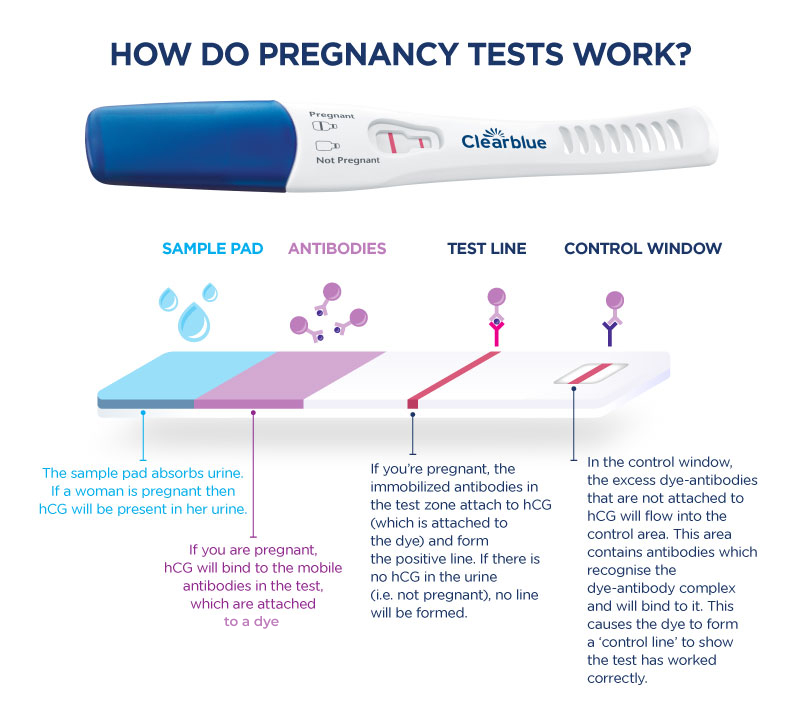
Most home pregnancy tests claim to be more than 99% accurate at detecting pregnancy from the day you expect your period. You can find out more about pregnancy tests, how to use them, how to read them, and the types available on our page about Clearblue® pregnancy tests.
In addition to urine pregnancy tests (like most home pregnancy tests), you can also detect pregnancy with pregnancy blood tests. These detect the hCG in the blood, but there are two types7:
- Qualitative pregnancy blood test. This measures whether there is any hCG hormone in the blood stream, with a positive or negative result, but won’t tell you how much hCG is present.
- Quantitative pregnancy blood test. This type of test actually measures the levels of hCG in the blood. In most instances, this test is only done in cases where a healthcare professional wants to know more about the state of the pregnancy, for example, if an ectopic pregnancy is suspected.
How do twins and multiples affect hCG levels?
Women pregnant with twins or multiples have high levels of hCG. This increased level of hCG could also be why some women who carry twins have severe morning sickness compared to women who are expecting only one baby. If you have a blood test to check your hCG levels and it’s higher than average, there is a chance that you are pregnant with more than one baby4,8.
Can hCG levels diagnose a miscarriage or an ectopic pregnancy?
Your hCG level can inform your doctor whether there is a risk of an ectopic pregnancy or whether a miscarriage has occurred. A declining or low rate of increase in hCG over 48 hours can be a sign of an ectopic pregnancy or miscarriage. In the case of an ectopic pregnancy, the hCG level may just plateau or increase at a very slow rate, but this can only be determined, usually in a doctor’s office or hospital, by using blood hCG levels to monitor how much hCG you have in the blood. If the hCG level continually declines, this points to a miscarriage having taken place or that the pregnancy may no longer continue. See your healthcare provider if you have any concerns9.
FAQs about hCG
What does hCG do to your body?
The hormone hCG ensures the corpus luteum, which forms in the ovary after ovulation, keeps producing progesterone during the first trimester until the placenta has developed.
Once the placenta has formed and produces progesterone, hCG levels go down as it’s no longer needed10, however they won’t fall below a level that would give a positive result on a pregnancy test.
When does your body start producing hCG?
After a fertilized egg implants in the uterus lining, the placenta begins to develop and produces increasing amounts of hCG.
This is why hCG is considered a marker for implantation5.
Is there a connection between hCG levels and morning sickness?
You may have been told that morning sickness means a healthy baby. It may be scant comfort when you’re feeling so sick all the time, but there might be a grain of truth in it.
There are studies showing a relationship between morning sickness, a healthy pregnancy, and rising levels of hCG, but the jury is still out.
What does a low level of hCG mean?
A low hCG level can mean different things depending on how far along you are. If you are very early in your pregnancy, then hCG levels will likely be very low but in a normal, healthy pregnancy they will naturally increase rapidly.
However, if your hCG level starts to decrease, there may be a risk you are having/have had a miscarriage11.
If your hCG level is consistently low, with no increase or decrease, or if you experience any pain or bleeding, see your doctor immediately to rule out the risk of an ectopic pregnancy, when the fertilized egg implants outside the uterus11.
Are high hCG levels a bad thing?
If you have an hCG level higher than expected for your stage of pregnancy, it’s possible that you miscalculated when you got pregnant, and you’re further along than you thought.
Alternatively, it may be that you are pregnant with twins or multiples, as hCG is generally higher in this case.
Molar pregnancy (growth of abnormal, non-cancerous cells in the uterus) can also cause an elevated hCG level, which is higher than normal12.
Should I check my hCG levels regularly?
Unless you are showing any symptoms that your pregnancy is not progressing as it should, it is unlikely that your doctor will check your hCG level.
If you are bleeding or have a history of miscarriage, you may have your hCG checked regularly13.
What level of hCG is expected after a pregnancy loss?
Your hCG levels will normally decline after a miscarriage until they go back to close to zero within 6 weeks (depending on when the miscarriage occurred)14.
What can interfere with my hCG levels?
A very small number of non-pregnant peri and postmenopausal women may have very low levels of hCG in their urine due to changing hormone levels associated with the menopause transition.
This could carry the risk of returning a false positive result should these women use a high sensitivity test for hCG. See section above "hCG levels in perimenopause".
False-positive results are very rare, but an early loss or some very rare cancers can cause the test to detect hCG13.
Also, if you are on any fertility medication containing hCG, (usually given by injection) this can also affect your test results.
However, other medications like hormonal contraceptives or antibiotics won’t affect your hCG level13.
HCG is one of the most important hormones in early pregnancy. It’s the reason the test turns positive. It continues to increase over the first trimester as your baby continues to grow and you may feel a little nauseous.
Read more

When can I take a pregnancy test?
If you think you might be pregnant, you want to know right away. But it’s important to understand what’s happening in your body so you know how soon you can test. Read on to learn all about when to us…

What does getting a negative pregnancy test result mean?
When you miss your period, you may be wondering ‘Am I pregnant?’ Perhaps you’re feeling a little nauseous, your breasts are tender, or you’re experiencing other early signs of pregnancy, but you’ve ta…

What does getting a positive pregnancy test result mean?
I got a positive result, now what? Is the result accurate or not? What should I do next? Feeling overwhelmed when you take a home pregnancy test is perfectly normal, especially if the result comes out…


Save $2
- Baird DD, Weinberg CR, McConnaughey DR, Wilcox AJ. Rescue of the corpus luteum in human pregnancy. Biol Reprod. 2003; 68(2):448-56.
https://pubmed.ncbi.nlm.nih.gov/12533407/ - Grün JP, Meuris S, De Nayer P, Glinoer D. The thyrotrophic role of human chorionic gonadotropin (hCG) in the early stages of twin (versus single) pregnancies. Clin Endocrinol (Oxf). 1997; 46(6):719-25.
https://pubmed.ncbi.nlm.nih.gov/9274703/ - https://pubmed.ncbi.nlm.nih.gov/18083748/
- https://www.fertstert.org/article/S0015-0282(12)02233-9/pdf
- Gnoth C. and Johnson S. Strips of Hope: Accuracy of Home Pregnancy Tests and New Developments. Geburtshilfe Frauenheilkd 2014;74(7):661–669.
https://www.ncbi.nlm.nih.gov/pmc/articles/PMC4119102/ - Osterman MJK, Hamilton BE, Martin JA, Driscoll AK, Valenzuela CP. Births: Final data for 2021. National Vital Statistics Reports; vol 72, no 1. Hyattsville, MD: National Center for Health Statistics. 2023. DOI: https://dx.doi.org/10.15620/cdc:122047
- https://medlineplus.gov/ency/article/003432.htm
- https://www.marchofdimes.org/complications/being-pregnant-with-twins-triplets-and-other-multiples.aspx Updated June 2021
- https://www.ncbi.nlm.nih.gov/books/NBK132768/ published 2012
- https://www.hormone.org/your-health-and-hormones/glands-and-hormones-a-to-z/hormones/human-chorionic-gonadotropin-hormone-hcg
- 602ccb44d38c81.31989740.pdf (wwl.nhs.uk)
- Molar Hcg | South Tees Hospitals NHS Foundation Trust
- hCG Levels | The American Pregnancy Association
- 02-80-Monitoring-your-hormone-levels-in-early-pregnancy.pdf (mft.nhs.uk)