
On average, how long does it take to get pregnant? What to expect

Nothing in this article is or should be construed as medical advice; for any medical questions, consult your healthcare professional.
From the swoon-worthy plots in romance novels and movies to the anecdotal conception stories we hear from friends, it’s no wonder many women believe that as soon as they start trying, the odds of getting pregnant are high. It can come as a shock when pregnancy tests continue to show negative results after a month (or 3, or 6…) of trying. You may find yourself wondering, just how hard is it to get pregnant?
So on average, how long does it take to get pregnant? It depends on a lot of factors, like your age, cycle regularity and lifestyle, though the general rule of thumb is that most healthy TTC couples can expect to try for up to a year.1
Let’s dive into the disconnect between how long we think it takes to get pregnant and what the science actually tells us to expect at different ages.
What do women think the average time to get pregnant is?
We asked 1000 women, with an average age of 33 years, about their fertility.2* Here’s what we learned:
74% said “I want to maximize my chances of getting pregnant as soon as possible,” while the rest said they’d prefer to let nature take its course. When it comes to planning their pregnancy, women from different countries have different attitudes, with women from the US especially wanting to maximize their chances of conception.
Younger women, aged 20–24 years, are more optimistic about how long it takes to get pregnant than older women. This younger group believes it takes around 4 and a half months to conceive,while those aged over 35 years think it takes nearly 6 months on average.2
We also asked mothers to think about a recent planned pregnancy and tell us how they felt about the amount of time it took to get pregnant: 43% said that it took longer than expected, and they became worried — wondering, “Why am I not pregnant yet?” — after an average of 5.9 months. And 27% felt the same worry after the first 3 months.2
Note: This study was funded by SPD Swiss Precision Diagnostics GmbH, the manufacturers of Clearblue® pregnancy and ovulation tests. Professor Michael J. Zinaman, MD FACOG FACS, Professor of Obstetrics and Gynecology, Albert Einstein College of Medicine is a past advisory board member for SPD Development Company Ltd.
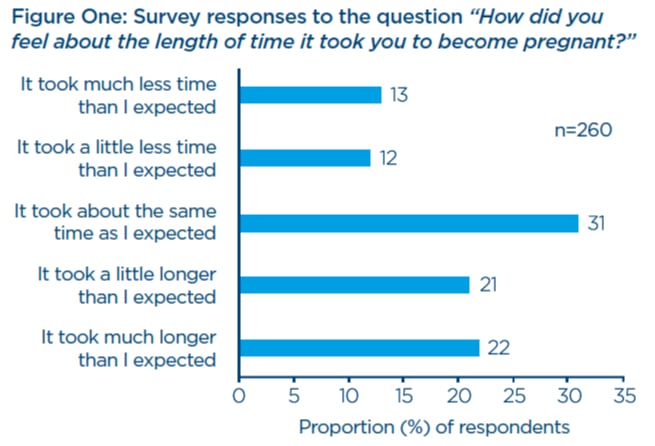
And that’s not all the survey found, the research also showed that many women don’t understand their cycles. This highlights a gap in knowledge, as a large number of US women believe that pregnancy is possible following intercourse on any day of the cycle.
*This study was funded by SPD Swiss Precision Diagnostics GmbH, the manufacturers of Clearblue® pregnancy and ovulation tests.
Why does this research matter to you?
Many women don’t know the reality of just how long it takes to get pregnant. Many expect to get pregnant as soon as they start trying, but if you’re under 35 and in good health, it is perfectly natural for it to take up to a year.1 That said, expected timelines vary depending on your age. Taking steps to boost your fertility health and tracking your most fertile days can help, too, regardless of age.
Breaking down the average time to get pregnant by age
In general, about 30–40% of healthy couples will conceive in the first month of trying.1 But it’s also true that approximately 15% of couples will have difficulty conceiving, meaning a lack of positive pregnancy test results after 12 months of regular, unprotected sex in women younger than 35, or after 6 months in women aged 35 and older.1 Let’s explore the chances of getting pregnant by age.
In your 20s: the best odds of getting pregnant
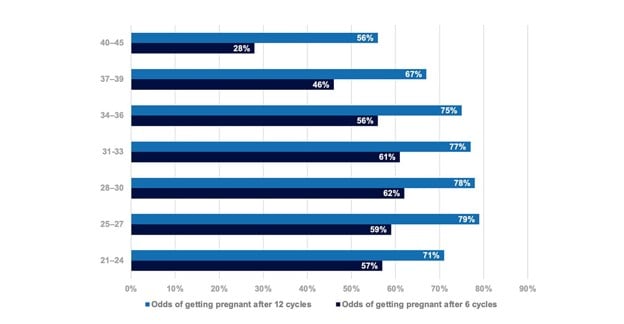
According to one study, many couples TTC in their 20s conceive within a few months, and roughly 7–8 out of 10 will be pregnant within a year when they have regular, well‑timed intercourse.3
| Age | The odds of getting pregnant after 6 cycles3 | The odds of getting pregnant after 12 cycles3 |
|---|---|---|
| 21–24 | 57% | 71% |
| 25–27 | 59% | 79% |
| 28–30 | 62% | 78% |
In your 20s, each cycle has the highest chance of conception and age‑related infertility is rare, so you also have the widest time window to build a larger family. One study revealed that couples who want two or three children can safely delay TTC longer if they start in their 20s, because there’s more time for multiple pregnancies and recovery between them; that said, if you want a family of two or more children, studies show that starting earlier can increase your odds of having a larger family.4
But remember: That's simply data, not a rule book. Plenty of families build their perfect size on their own timeline, and that's just as valid.
In your early 30s: the average time to get pregnant shifts
For the first time in human history, there are more women in their 30s having babies than those in their 20s.5 Many are choosing to wait longer to become mothers — until a time when raising children fits with their career and life goals6 — so there’s often an expectation that when you start trying for a baby, it will happen quickly. In your early 30s, many couples (61%) still conceive within a few months, but it’s common for it to take longer than it would have in your 20s; most (77%) will conceive within a year if there are no underlying fertility issues.3
Research suggests that if you hope to have two children and are comfortable with a small risk of falling short, you can often start trying in your early 30s.4
Age 35 and older: key considerations for conception
The reality is that getting pregnant takes longer the closer you get to 40. From age 35 onward, natural conception is still very possible, but it often takes more time, the monthly chance of pregnancy is lower and the likelihood of needing help from a fertility specialist gradually increases.4
| Age | The odds of getting pregnant after 6 cycles3 | The odds of getting pregnant after 12 cycles3 |
|---|---|---|
| 34–36 | 56% | 75% |
| 37–39 | 46% | 67% |
| 40–45 | 28% | 56% |
In one study, women between 40 and 45 years old were 60% less likely to conceive during any given cycle than women in their early 20s.3 And when it comes to achieving family planning goals, research shows that couples who want two or three children and wish to keep their chance of falling short may need to start trying before their mid‑30s, especially if they prefer to avoid IVF.4
Be kind to yourself if it’s hard to get pregnant at first
If your fertility journey leaves you thinking, “Why am I not pregnant yet?” or “Why does it take so long to get pregnant?” — know that you’re not alone. Many women’s “conceivinghood” stories don’t go how they expect, but there’s no one path to motherhood. You may find strength and comfort in hearing others’ TTC stories, educating yourself on ways to emotionally and physically prepare for pregnancy, finding ways to keep sex fun and exciting or leaning on your support system. Remind yourself that there are many factors that can affect fertility and ovulation, and there are more options than ever to help boost the odds of getting pregnant, from fertility medications to TTC tech, in vitro fertilization and beyond. If you suspect you or your partner might be struggling with symptoms of infertility, contact your healthcare professional to run tests and make a treatment plan.
FAQ
How long does it usually take to get pregnant?
Most healthy couples can expect conception within a year of regular, unprotected sex, though timing varies based on age and individual factors.1
Is it normal to not get pregnant right away?
Yes, it’s common for conception to take several months (or up to a year) of trying, even for younger couples.
How likely are you to get pregnant each month?
If you have regular cycles and no known fertility problems, your chance of getting pregnant in any one month (one menstrual cycle) is roughly 25–30% in your early 20s, and it gradually declines with age, especially after 35.1
Does timing sex around ovulation really help?
Yes, focusing intercourse during your most fertile days increases the likelihood of conception.
When should you talk to a doctor?
If you’re under the age of 35 and haven’t conceived after a year, or over 35 years old and haven’t after 6 months, it’s a good idea to make an appointment with your healthcare provider.
Remember every fertility journey is unique
Despite what many women may think, it’s perfectly normal for conception to take time — even up to a year for healthy couples under 35.1 There’s no single timeline or right way to become a parent. What matters most is caring for your emotional and physical well-being, seeking support when you need it and trusting that there are many options and resources available to help you along the way. Be gentle with yourself, celebrate each step forward and know that hope and help are always within reach.
Declaration of interest
This study was funded by SPD Swiss Precision Diagnostics GmbH, the manufacturers of Clearblue® pregnancy and ovulation tests. Professor Michael J. Zinaman, MD FACOG FACS, Professor of Obstetrics and Gynecology, Albert Einstein College of Medicine is a past advisory board member for SPD Development Company Ltd.
Related Articles
- Trying-to-conceive tips: Top questions about sex and TTC
- Myths and facts about fertility nutrition
- How to prepare your body for pregnancy: 12 tips and the science behind them

Looking for insights on your health journey? Clearblue® sends you curated, science-backed articles right to your inbox.
Read more

Trying-to-conceive tips: Top questions about sex and TTC
Blog Tips and tricks for getting pregnant faster Trying-to-conceive tips: Top questions about sex and TTC

Myths and facts about fertility nutrition
Blog How to get pregnant? Myths and facts about fertility nutrition

How to prepare your body for pregnancy: 12 tips and the science behind them
Blog How to get pregnant? How to prepare your body for pregnancy: 12 tips and the science behind them
Sources
- Adebisi OY, Singh M, Tobler KJ. Female Infertility. StatPearls Publishing; 2025. Accessed January 29, 2026. https://www.ncbi.nlm.nih.gov/books/NBK556033/
- Zinaman M, Johnson S, Foster L, Zanzi G, Mollard C. Fertility Knowledge of Women in the United States [6M]. Obstetrics & Gynecology. 2019;133:141S. Accessed January 29, 2026. doi: 10.1097/01.AOG/01.AOG.0000559279.68081.a5
- Wesselink AK, Rothman KJ, Hatch EE, Mikkelsen EM, Sørensen HT, Wise LA. Age and fecundability in a North American preconception cohort study. Am J Obstet Gynecol. 2017;217(6):667.e1-667.e8. Accessed January 29, 2026. doi: 10.1016/j.ajog.2017.09.002
- Habbema JD, Eijkemans MJ, Leridon H, te Velde ER. Realizing a desired family size: When should couples start?. Hum Reprod. 2015;30(9):2215-2221. Accessed January 29, 2026. doi: 10.1093/humrep/dev148
- Martin JA, Hamilton BE, Osterman MJK. Births in the United States, 2024. NCHS Data Brief. 2025 Jul;(535):1–8. Accessed January 29, 2026. doi: https://dx.doi.org/10.15620/cdc/174613
- Datta J, Maxwell KJ, Mitchell KR, Lewis R, Wellings K. Factors shaping the timing of later entry into parenthood: Narratives of choice and constraint. Social Sciences & Humanities Open. 2023;8(1):100700. Accessed January 29, 2026. doi: https://doi.org/10.1016/j.ssaho.2023.100700