
Healthcare Professionals
Clearblue® Fertility & Ovulation Products

Maximize her chances of getting pregnant with Clearblue®
Today’s busy lifestyle means women often wish to actively plan their family and expect pregnancy to happen quickly. Yet, only 1 in 3 couples get pregnant in the first month of trying.1 Clearblue® offers a range of ovulation test and fertility products to help her try to conceive by identifying her most fertile days, tracking her cycle or predicting her periods:
- Clearblue® Smart Ovulation Test
- Clearblue® Advanced Digital Ovulation Test
- Clearblue® Digital Ovulation Test
- Clearblue® Fertility Monitor with Touch Screen
- Clearblue® Period Tracker
The fertile window
Changes in hormone levels control the fertile window
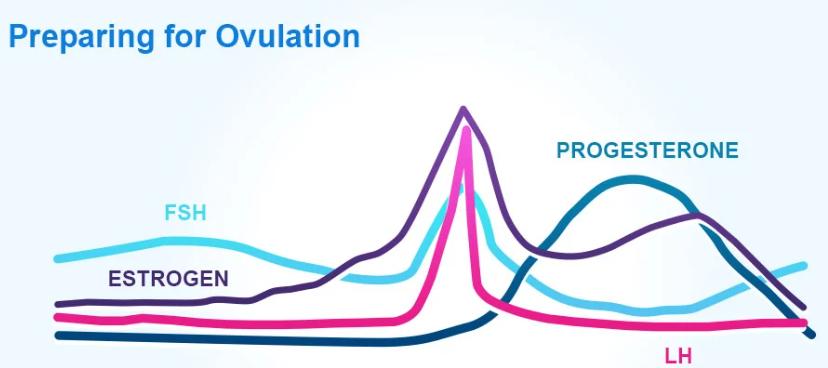
The menstrual cycle is regulated by the anterior pituitary gonadotropins - follicle stimulating hormone (FSH) and luteinizing hormone (LH) - and by the gonadal sex hormones estrogen and progesterone.2 The coordinated interaction of these hormones promotes oocyte recruitment and development, creates a sperm-friendly environment and thickens the endometrium.3
The fertile window refers to the few days in each cycle where a woman can get pregnant, typically spanning six days: the five days leading up to ovulation and the day of ovulation itself. Our Clearblue® Ovulation Tests track her hormone levels to identify her best days to try to conceive.4-8
Follicle Stimulating Hormone (FSH)
Rising FSH levels at the start of the menstrual cycle recruit a cohort of ovarian follicles and support their growth. As these follicles grow, they produce estrogen. Once estrogen levels are high enough, they provide negative feedback to the brain (pituitary gland) and stop the release of more FSH. This allows for one dominant follicle to mature while the others stop growing.9
Estrogen (E2)
Estrogen levels, specifically estradiol (E2), gradually rise from the start of the cycle as follicles develop. As a result, the endometrium thickens, and cervical mucus becomes thinner to facilitate survival and transport of sperm. 10 A sustained increase in E3G in urine, the urinary metabolite of estradiol, can be used to identify the onset of the fertile window, giving women an advanced notice of their peak fertile days.
Luteinizing hormone (LH)
High estradiol levels trigger the LH surge. Studies show that a surge in LH level occurs 24-36 hours prior to ovulation,2 and that this LH surge is an accurate and reliable marker of impending ovulation.7,8,10-12 The urinary LH surge pinpoints the two peak fertile days of a woman's cycle, with intercourse on these days being shown to be associated with the highest likelihood of conception.13
Progesterone (P4)
Once ovulation has occurred, the dominant follicle forms the corpus luteum, a temporary gland that produces progesterone. Measuring pregnanediol 3-glucoronide, the urinary metabolite of progesterone, can be used to confirm ovulation.14
Right timing boosts conception success
1 in 2 couples could be trying to conceive at the wrong time.15 There are two main reasons why couples may incorrectly time intercourse:16 first, couples may be unaware of the most appropriate time in their cycle to try to conceive; and second, the assumption that the fertile window usually occurs between days 10-17 of the menstrual cycle is often incorrect.13,15-18 Regular cycles can range from 21 to 35 days, with data showing 52% seeing a variation of up to 5 days between cycles, 19 making it hard to identify the fertile window, which is crucial for pregnancy success.
Clearblue® Fertility and Ovulation Products
The Clearblue® Period and Cycle Tracker App allows women to monitor their menstrual cycles and symptoms, helping them build awareness of their natural cycle patterns.
The Clearblue® Smart Ovulation Test is a clinically validated, camera-read ovulation test that is 99% accurate at detecting the LH surge and provides clear results in the Clearblue® Period Cycle Tracker app. After testing, she simply uses the app to capture an image of her result. The app will analyze, display and record the outcome – indicating whether the LH surge has been detected – and automatically plot her LH result on a graph for easy tracking.
The Clearblue® Smart Ovulation Test detects low LH surges – even lower than 25mIU/ml.
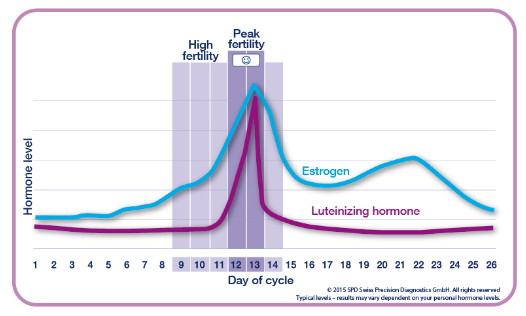
The Clearblue® Fertility Monitor and Clearblue® Advanced Digital Ovulation Test measure both estrogen and LH to help her identify her High and Peak Fertility days, enabling women to time intercourse on the days when conception is most likely.
The Clearblue® Fertility Monitor is proven to increase the chances of getting pregnant naturally by
82%.20 It typically identifies up to 6 fertile days maximizing her chances of getting pregnant. Clinical studies have found urinary measurements by Clearblue® Fertility Monitor closely reflect serum concentrations of the hormones8 and the LH surge detection by the monitor accurately predicts ovulation.7 The Clearblue® Fertility Monitor features an intuitive touch screen display and other features that make it an effective and easy-to-use aid for women trying to conceive. The monitor also stores up to 6 cycles of data which can then be retrieved and shared with Healthcare Professionals.
The Clearblue® Advanced Digital Ovulation Test is over 99% accurate at the detecting the LH surge. It identifies High and Peak Fertility days by tracking E3G and LH, typically identifying 4 or more fertile days.21 The digital display shows an unmistakable result in the form of a smiley face when a fertile day is detected.
The Clearblue® Digital Ovulation Test is also over 99% accurate at detecting the LH surge. It accurately identifies her two most fertile days to get pregnant naturally. It is a simple home ovulation test kit, which provides easy-to-read, easy-to-understand digital results for more accurate reading in consumers' hands.22
Both of our Clearblue® Digital Ovulation Tests, the Clearblue® Smart Ovulation Test and the Clearblue® Fertility Monitor have a smart algortihm that adapts to her unique hormone profile for personalized, cycle knowledge. Additionally, the Clearblue® Fertility Monitor is also designed to detect all her fertile days.23
- Taylor A. ABC of subfertility: extent of the problem. BMJ. 2003 Aug 23;327(7412):434-6. doi:10.1136/bmj.327.7412.434.
- Martinez AR, et al. Prediction and detection of the fertile period: the markers. Int J Fertil
Menopausal Stud. (1995) 40: 139–155. - Burger, HG. Estradiol: the physiological basis of the fertile period. Int J Gynecol Obstet 1989; Suppl 1:5-9.
- Johnson S, et al. Development of the first urinary reproductive hormone ranges referenced to independently determined ovulation day. Clin Chem Lab Med. (2015) 53: 1099–1108. 8.
- Roos J, et al. Monitoring the menstrual cycle: Comparison of urinary and serum reproductive hormones referenced to true ovulation. Eur J Contracept Reprod Health Care. (2015) 20: 438–450. 9.
- World Health Organization. A prospective multicentre study to develop universal immunochemical tests for predicting the fertile period in women. World Health Organization Task Force on Methods for the Determination of the Fertile Period, Special Programme of Research, Development and Research Training in Human Reproduction. Int J Fertil. (1985) 30:18–30. 10.
- Behre HM, et al. Prediction of ovulation by urinary hormone measurements with the home use Clearplan Fertility Monitor: comparison with transvaginal ultrasound scans and serum hormone measurements. Hum Reprod. (2000) 15: 2478–2482. 11.
- Tanabe K, et al. Prediction of the potentially fertile period by urinary hormone measurements using a new home use monitor: Comparison with laboratory hormone analyses. Hum Reprod. (2001) 16: 1619–1624.
- Orlowski M, Sarao MS. Physiology, Follicle Stimulating Hormone. [Updated 2023 May 1]. In: StatPearls [Internet]. Treasure Island (FL): StatPearls Publishing; 2025 Jan-. Available from: https://www.ncbi.nlm.nih.gov/books/NBK535442/
- Corson SL. Self-prediction of ovulation using a urinary luteinizing hormone test. J Reprod Med
1986;31(8 Suppl):760-3. - Guida M, Tommaselli GA, Palomba S, Pellicano M, Moccia G, Di Carlo C, et al. Efficacy of methods for determining ovulation in a natural family planning program. Fertil Steril 1999;72(5):900-4.
- Guermandi E, Vegetti W, Bianchi MM, Uglietti A, Ragni G, Crosignani P. Reliability of ovulation tests in infertile women. Obstet Gynecol 2001;97(1):92-6.
- Wilcox AJ, Weinberg CR, Baird DD. Timing of sexual intercourse in relation to ovulation. Effects on the probability of conception, survival of the pregnancy, and sex of the baby. N Engl J Med 1995 Dec 7;333(23):1517-21.
- Su, H.-W., Yi, Y.-C., Wei, T.-Y., Chang, T.-C. and Cheng, C.-M. (2017), Detection of ovulation, a review of currently available methods. Bioengineering & Translational Medicine, 2: 238-246. https://doi.org/10.1002/btm2.10058
- Johnson SR, et al. Hum Reprod. 2011;26:i236
- Louis GM, et al. Periconception window: advising the pregnancy planning couple. Fertil Steril. (2008) 89 (Suppl 2): e119–121.
- Johnson SR, et al. Women’s knowledge regarding ovulation and most likely time of conception. Hum Reprod. (2011) 26 (Suppl 1): i236
- Robinson JE and Ellis JE. Mistiming of intercourse as a primary cause of failure to conceive: results of a survey on use of a home-use fertility monitor. Curr Med Res Opin. (2007) 23: 301–306.
- Soumpasis I, Grace B, Johnson S. Real-life insights on menstrual cycles and ovulation using big data. Hum Reprod Open. 2020 Apr 16;2020(2):hoaa011. doi: 10.1093/hropen/hoaa011
- In the first cycle of use vs not using the Clearblue Easy Fertility Monitor. Study of 991 women in the US (2002).
- In a study, 4 or more fertile days were identified in 80% of cycles (2012)
- Johnson S, Ellis J, Godbert S, Ali S, Zinaman M. Comparison of a digital ovulation test with three popular line ovulation tests to investigate user accuracy and certainty. Expert Opin Med Diagn 2011;5:467-473.
- Number of fertile days will vary. In a German study of 149 cycles, Monitor results correlated with serum hormone levels & ultrasound observed ovulation