
Defining motherhood: Why it’s more than biology or family structure

In this article
- What makes someone a mother? Understanding the meaning of motherhood
- Types of mothers: The biological spectrum of motherhood
- The path-to-motherhood spectrum
- The motherhood experience spectrum
- The family structure spectrum
- Why defining motherhood as a spectrum matters
- The meaning of motherhood today: There’s room for everyone
- FAQ about motherhood and what defines a mother
Motherhood is often spoken about as if it were a fixed point — something clearly defined, easily named. But the closer it’s examined, the less fixed that “mother” definition feels.
Defining motherhood is anything but straightforward. The reality of motherhood stretches across different experiences, timelines and relationships. It exists in ways that don’t always align with expectation, and in forms that aren’t always immediately visible.
What begins to emerge isn’t a single definition, but something broader — something that resists being reduced to a single path or outcome.
Motherhood, in lived experience, is not a single story.
It’s a spectrum.
What makes someone a mother? Understanding the meaning of motherhood
At its most basic level, a mother is someone who gives birth to or raises a child. But that definition only tells part of the story. What defines a mother is much more.
Motherhood is shaped by care and intention. It’s built through presence, connection, responsibility and love — not just biology. While giving birth is one way to become a mother, it’s far from the only way.
Non-biological mothers may be called adoptive mothers, stepmothers, foster mothers or maternal figures, but many simply go by “mom.” Because in lived experience, motherhood isn’t defined by DNA. It’s defined by the relationship.
At a deeper level, many people recognize something familiar in the act of “mothering,” even outside of traditional roles. It’s the instinct to care, to protect, to nurture growth, to hold space for someone else’s becoming.
This doesn’t mean everyone is a mother in the same way, or that the role of raising a child can be generalized. But it does point to something broader: that the qualities often associated with motherhood — care, attention, devotion — are human capacities, not limited to one identity or path.
Seen this way, motherhood becomes both a role and a way of relating; something some people live every day, and something many people touch in different forms throughout their lives. Rather than a single definition, motherhood is better understood as a spectrum — with countless ways to exist within it.
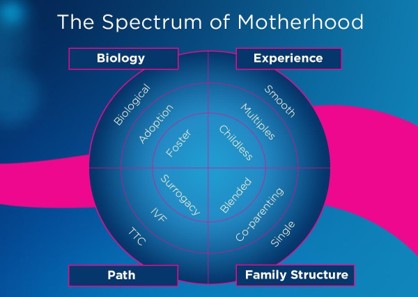
Types of mothers: The biological spectrum of motherhood
There are many types of mothers, each defined not by biology alone, but by the role they play in a child’s life.
Across the spectrum of biology, motherhood can look like:
Biological pregnancy
Carrying and giving birth to a child with a genetic connection.
Gestational carrier (surrogate)
Carrying a pregnancy for someone else, without a genetic link to the child.
Egg donor recipient
Becoming a parent through a donated egg, with or without a genetic connection.
Adoptive mother
Building a family through adoption, forming bonds that are intentional and lifelong.
Stepmother
Parenting within a blended family, often navigating complex emotional dynamics and deep care.
Foster mother
Providing stability, safety and support — sometimes temporarily, sometimes long-term.
Maternal figure
Aunts, godmothers, mentors, chosen family — people who take on a mothering role through presence and care.
DNA is one way to connect to a child, but it’s not the defining one. Motherhood is created in the day-to-day: showing up, caring, guiding, supporting. Biology may shape a beginning, but it doesn’t determine the depth or legitimacy of the relationship.
The path-to-motherhood spectrum
There’s a common idea that motherhood follows a straightforward path. In reality, it rarely does. And a mother’s timeline doesn’t determine their legitimacy or worthiness.
Experiences across the spectrum of the paths to motherhood can include:
First-cycle conception
Becoming pregnant quickly, without prolonged trying.
Fertility treatment (IUI, IVF)
Using medical support to conceive, often involving emotional, physical and financial investment.
A long trying-to-conceive (TTC) journey
Months or years of trying, often accompanied by uncertainty and hope.
Adoption wait
Waiting to be matched with a child, navigating systems that can be complex and unpredictable.
Foster placement
Becoming a parent through fostering, sometimes with little notice and evolving expectations.
Still hoping
Actively trying or planning for a child, without a clear timeline or outcome.
Living childless (not by choice)
Experiencing infertility or circumstances that prevent having children, often accompanied by grief that isn’t always visible
How long it takes to become a mother — or whether it happens at all — doesn’t define someone’s worth.
Motherhood, for many, includes waiting. It includes uncertainty. It includes paths that change along the way. And for those still hoping or navigating loss, their experiences are part of this conversation too.
The motherhood experience spectrum
Even when motherhood journeys look similar from the outside, the experience of motherhood can vary widely.
Across this spectrum exists:
Uncomplicated pregnancy
A relatively smooth pregnancy and postpartum experience.
Complicated pregnancy
Bed rest, medical interventions or health concerns that reshape expectations and daily life.
Multiples (twins, triplets+)
Parenting more than one baby at once, often with unique challenges and dynamics.
Pregnancy after loss
Carrying a pregnancy while holding previous grief, often with heightened anxiety and complexity.
Living childless (not by choice)
Continuing to navigate the absence of a hoped-for child.
Child-free by choice
Choosing not to have children of your own and directing that love toward nieces, nephews, or other little ones in your community.
There’s no hierarchy here; no version of motherhood is more valid than another. Some experiences are joyful. Some are difficult. Many are both at once. And for some, motherhood is something they’ve stepped away from — or never stepped into at all. That choice, too, deserves respect.
The family structure spectrum
Modern motherhood isn’t defined by what a family looks like from the outside. Love makes a family, not structure.
Across the family structure spectrum exist many experiences:
Heterosexual couple
A two-parent household with a mother and a father.
Same-sex couple/LGBTQ+ parents
Families built through partnership, often involving unique paths to parenthood
Single parent by choice
Choosing to raise a child independently.
Single parent by circumstance
Parenting solo due to separation, loss or life changes.
Co-parents
Raising a child across households, sharing responsibilities in different ways.
Blended family
Families that come together through remarriage or partnership, often including stepparents and stepsiblings.
Community raising
Extended family, chosen family or collective care models where caregiving is shared.
None of these are “alternative” versions of family. They are families, period.
Love, stability and care are not dependent on structure. They’re built through family relationships — whatever form those connections take.
Why defining motherhood as a spectrum matters
For a long time, motherhood has been framed as a binary: You either are a mother, or you’re not. But that framing leaves too many people out.
It overlooks the complexity of real experiences, flattening journeys that are anything but simple. Binary thinking creates narrow expectations that don’t reflect how people actually live and care for one another. Motherhood isn’t solely defined by medical definitions, social expectations or cultural norms.
Expanding how we think about and define motherhood doesn’t take anything away from anyone. It makes space — for different paths, different choices, different outcomes and different kinds of love.
When we recognize motherhood as a spectrum, we allow more people to feel seen in their experiences — without needing to fit into a single, predefined box.
The meaning of motherhood today: There’s room for everyone
Motherhood isn’t a single identity or a fixed definition. It’s a spectrum shaped by connection, care and intention — not just biology, timeline or structure. The modern motherhood meaning encompasses people who are raising children, people who are trying to, people who have experienced loss, people who have chosen a different path, and everyone in between.
And at its core, motherhood reflects something deeply human: the impulse to care for one another. It’s the instinct so many have to nurture, to guide and to hold space for growth.
Some people live that out as mothers in the traditional sense. Others express it in different ways, across relationships, communities and moments of care that may never be named as such.
There’s no hierarchy of experiences or single version of motherhood that matters more than another. Only a vast, evolving definition — one that’s big enough to hold all of it.
Wherever someone falls on that spectrum, there’s room for them here.
FAQ about motherhood and what defines a mother
What makes someone a mother?
A mother is someone who births or raises a child, but more broadly, motherhood is defined by connection, care and intention — not biology alone.
Can someone be a mother without giving birth?
Yes! Adoptive mothers, stepmothers, foster mothers and maternal figures all embody motherhood through their relationships and roles.
What is a non-biological mother called?
Common terms include adoptive mother, stepmother, foster mother or maternal figure, though many simply use “mom” regardless of biology.
Does biology define motherhood?
No. Biology is one path to motherhood, but it’s not the only one — and it doesn’t determine the depth or validity of the relationship.
What are the different types of mothers?
Motherhood includes many roles and experiences, from biological mothers to adoptive, foster, step and chosen maternal figures, as well as a wide range of family structures and life paths.
What are the different roles of a mother?
A mother can take on many roles, which may shift over time depending on a child’s needs and the family dynamic. These can include caregiver, protector, teacher, emotional support system and guide. Beyond these roles, motherhood often involves creating a sense of safety, stability and belonging. While the specifics may look different for every family, the core of motherhood is rooted in care, responsibility and a commitment to supporting a child’s growth and well-being.
Read more

Mum’s the word: Rethinking a woman’s ‘purpose’
Blog | Mum’s the word: Rethinking a woman’s ‘purpose’

Supporting non-traditional moms: Tips for family and friends
Blog After the resultsSupporting non-traditional moms: Tips for family and friends

Age and fertility: The pros and cons of waiting to have children
Blog How to get pregnant? Age and fertility: The pros and cons of waiting to have children