
The modern village: Finding support through fertility, pregnancy & beyond

In this article
- What is a modern village?
- It takes a village: Why your support system matters
- Different types of support you might need
- Building your modern village at each stage
- When you’re planning or TTC
- When you’re navigating infertility or loss
- During pregnancy
- When spacing children or deciding to stop
- Where to find your people
- Tips for cultivating meaningful support
- FAQ
- Building a modern village that shows up for you
Even in today’s hyper-connected world, the fertility journey can feel profoundly isolating.
You’ve probably heard the phrase “it takes a village.” But what does that actually look like today? For many people, the answer isn’t only the nearby family or tight-knit neighbors our parents and grandparents relied on — it's also a group chat, an online community, a few close friends scattered across different cities and a chosen family that shows up for you.
Whether you’re trying to conceive (TTC), navigating pregnancy or figuring out what comes next, the people in your corner can make all the difference. This guide will help you map out who you need, where to find them and how to cultivate the kind of support — online and in real life — that actually shows up when it matters.
What is a modern village?
A modern village is the support system you intentionally build around yourself during your fertility and parenting journey.
It may include:
- Close friends and family
- Healthcare professionals
- Therapists or counselors
- Online communities
- Local parent or fertility support groups
- Chosen family or trusted mentors
Unlike the traditional “villages” of our parents and grandparents built mostly through proximity, modern villages often blend digital and real-world relationships. Both can be valid, meaningful and deeply supportive.
It takes a village: Why your support system matters
Support throughout your fertility, pregnancy and postpartum journey isn’t just nice to have; it can shape your experience emotionally and physically . Research shows that social support can offer tangible benefits for physical and mental health, helping people navigate the stress and uncertainty that often accompany the transition to parenthood.1
Practical and informational support matter too. Practical support with everyday tasks can ease your mental load during particularly demanding stretches. Having a team of professionals who can provide trusted information and guidance helps improve your overall experience and confidence throughout the journey.
Everyone’s needs are different, and whatever yours look like right now, they're valid. It’s also completely normal to face barriers when building your support system; you may live far from family, worry about becoming a “burden” to loved ones or simply not know where to start. And whatever shape your village takes today, it will almost certainly look different a year from now. That's not a flaw in the system — that's the system working.
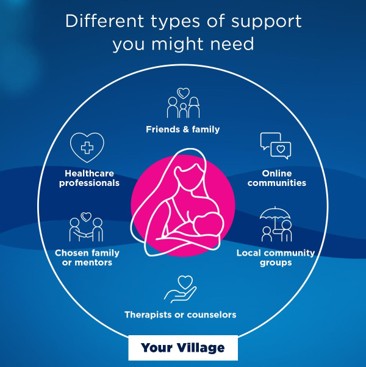
Different types of support you might need
You don’t need every type of support from one person. Everyone brings something unique to the table, and the people best suited to support you emotionally may not be the same ones you turn to for practical help or information. A strong village is usually made up of people who each fill a distinct role — and that’s exactly what makes it work.
- Emotional support: A compassionate listener who validates your feelings and shows up for you through the highs and lows.1
- Informational support: Trusted guidance from people who have been through similar experiences, healthcare providers and evidence-based resources that help you know what to expect.1
- Practical support: Hands-on help with day-to-day tasks like childcare, meal prep, transportation to appointments or other logistics.
- Professional support: Ob-gyns, doulas, fertility specialists, therapists, lactation consultants and pregnancy care programs like March of Dimes Supportive Pregnancy Care.
- Community support: Online forums, local groups, faith communities or workplace networks that help you feel less alone and more connected.1
You don’t need all of these from the same person, or even at the same time. Your village is a collection of people who show up for you in their own ways, at the moments throughout your journey when you need them most.
Building your modern village at each stage
Your support needs will evolve — and your village should too. Here’s what that can look like at each stage.
When you’re planning or TTC
Contemplate who you want to share this journey with. It’s completely okay to keep things private at first. When you think you may be ready for support, consider:
- Trusted friends or family members who will respect your boundaries
- Anonymous online communities (Reddit, Facebook groups)
- Your healthcare provider for medical guidance (Note: If you’re over 40 or taking certain medications, you may want to speak with your healthcare provider sooner.)
- A therapist if anxiety or stress feels overwhelming
When you’re navigating infertility or loss
Dealing with the grief of infertility or loss is often when specialized support makes a difference. Look for people who won’t minimize your experience with platitudes and will be honest about the support you need. Consider seeking:
● People who will listen to your experience — not try to fix it
● Infertility or pregnancy loss support groups2
● Fertility counseling or therapy2
● Online communities where you can connect with others going through similar experiences
During pregnancy
Pregnancy is one of the most common times people feel the pull to expand their village — and for good reason. Consider leaning on:
- Prenatal support groups or parent classes
- Experienced parents (with healthy boundaries)
- A birth support team (partner, doula, family, friends)
- People who can help with practical needs after birth
- Nonparent friends who help you stay grounded in your full identity
When spacing children or deciding to stop
This stage often gets less attention than the others — but the support needs here are just as real. Whether you're figuring out the timing of another child or feeling ready to close this chapter, your village might include:
- Parents in similar life stages
- Childcare or babysitting networks
- People who respect your timeline and choices without pressure or unsolicited opinions
- Support navigating family planning decisions
Where to find your people
Finding your people starts with knowing where to look. Support exists in more places than you might expect — online and off, professional and personal, and sometimes in corners of your life you'd never think to check.
Online communities: Peer forums, moderated groups and communities within trusted organizations can provide connection — especially if you’re geographically isolated or want anonymity:
- Facebook groups
- BabyCenter forums
- Other online pregnancy/TTC communities/postpartum groups
Local resources:
- Hospital support groups
- RESOLVE: The National Infertility Association chapters
- Prenatal classes
- New parent groups
- March of Dimes Supportive Pregnancy Care
Professional networks:
- Therapists specializing in fertility
- Doulas
- Lactation consultants
Unexpected places:
- Workplace parent groups
- Faith communities
- Neighborhood apps
Your existing network: Don’t overlook the people already in your life — friends or family may surprise you with how much they’re willing to show up when you let them know you need it.
Tips for cultivating meaningful support
Finding your village is one thing — nurturing it is another. A few ways to build connections that actually hold:
- Be specific about what you need. People want to help but don’t always know how. Tell them exactly what would be helpful.
- Lead with vulnerability. Sharing your authentic experience (when you’re comfortable) invites others to do the same.
- Set boundaries. It’s okay to limit conversations about your fertility journey or to take breaks from certain support spaces.
- Give back when you can. Support is reciprocal — showing up for others strengthens your village.
- Quality over quantity. You don’t need a huge network. A few deeply supportive relationships are often more valuable than dozens of surface-level connections.
- Reevaluate regularly. Your support needs will change. It’s okay to shift who you lean on and when.
FAQ
What is a village in pregnancy?
A modern village is the support system you intentionally build around yourself during your fertility, pregnancy and parenting journey. It can include friends, family, healthcare professionals, therapists, online communities and trusted organizations.
Are online pregnancy support groups as helpful as in-person ones?
They can be. Online pregnancy support groups can provide emotional connection, shared experiences and practical advice — especially if you’re geographically isolated or prefer more privacy. For many people, the most helpful approach is a mix of both online and in-person support, depending on what feels most accessible and comfortable.
Who should be part of your support system when trying to conceive?
Your TTC support system might include a partner, trusted friends or family members, healthcare professionals and mental health counselors. Some people also find comfort in connecting with others going through similar experiences in peer communities or support groups. The most important factor is choosing people who respect your boundaries and support you in the ways you need.
Is it okay to keep your TTC journey private?
Of course. Many people choose to keep their TTC journey private, especially in the early stages. You get to decide who knows, when they find out and how much you share — and it’s okay for that to evolve as your journey does. Sharing more over time, or less, is all part of finding what works for you.
Where can I find free online pregnancy or postpartum support groups?
Free online support groups are often available through hospitals, nonprofit organizations and maternal health advocacy groups. Some national organizations offer virtual pregnancy, postpartum or loss support groups, and many healthcare systems host free community support sessions. If privacy is important to you, look for moderated groups run by trusted organizations with clear privacy policies.
Building a modern village that shows up for you
There’s no single “right” way to build your village. Building your village takes intention — and it won't happen all at once. But the support you cultivate along the way has a real impact: on how you feel, how you cope and how you experience every stage of this journey. Asking for help isn’t a sign of weakness — it’s how villages get built. You don't have to do this alone. You were never supposed to. The right people are out there, and when you find them, you'll wonder how you ever did this without them.


Sources
- Renbarger KM, Place JM, Schreiner M. The influence of four constructs of social support on pregnancy experiences in group prenatal care. Women’s Health Rep (New Rochelle). 2021;2(1): 154-162, Accessed February 5, 2025. https://pmc.ncbi.nlm.nih.gov/articles/PMC8243703/
- Banks S. The emotional and practical support needed during fertility treatment. European Fertility Society. Published April 28, 2025. Accessed February 5, 2025. https://www.europeanfertilitysociety.com/the-emotional-and-practical-support-needed-during-fertility-treatment